
How to Read a Script Without Sounding Like You're Reading
How to read a script without sounding like you're reading: mark it into breath groups, stress words and pauses, then check your pace. Paste your own script to see where it sounds written, and get a before and after view with marked phrases and pause cues. The marking is rule-based and English only.
Free · runs in your browser · nothing is uploaded
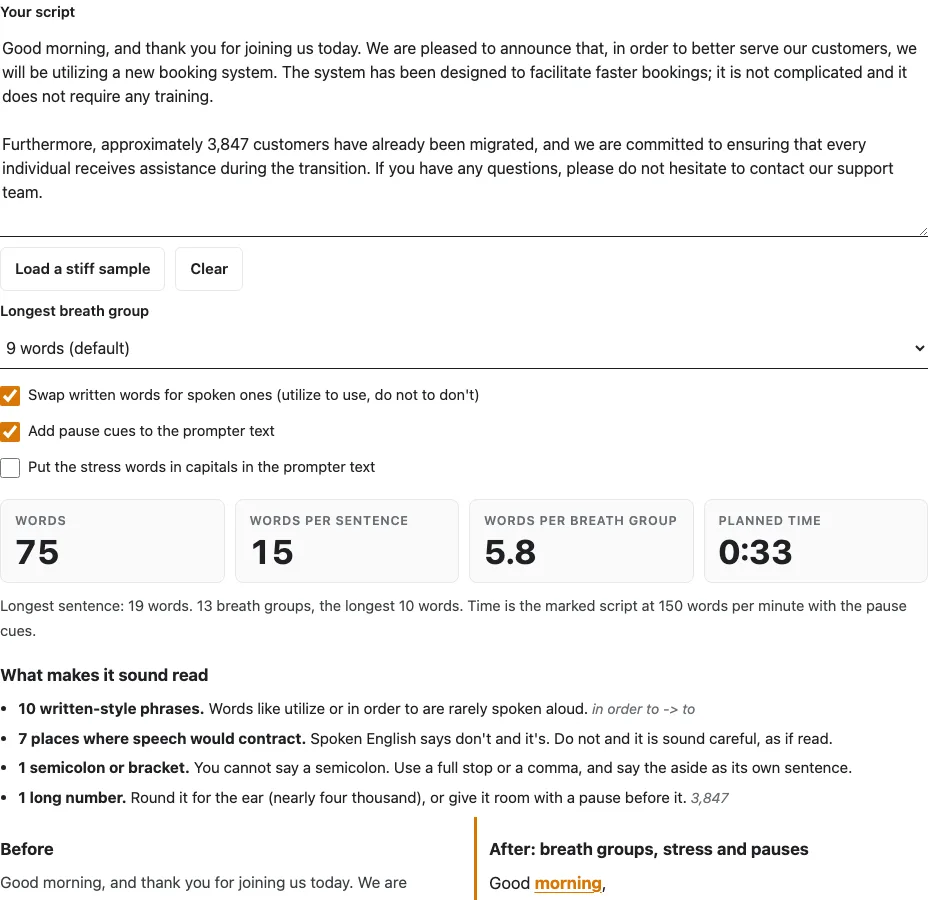
How to read a script without sounding like you’re reading? Write it the way you speak, cut it into the groups of words you can say in one breath, put the stress on the words that carry the point, and leave room to pause. This page does the marking for you. The box above holds a deliberately stiff sample; paste your own script and it shows the problems, rewrites written-style words into spoken ones, and lays out the script one breath group per line with the stress words underlined and the pauses tagged. Then you read it aloud against a stopwatch to check your pace, or send it to the prompter.
Paste your own script above, then try the 7, 9 and 11 word breath group limits on the same paragraph.
At a glance
A script sounds read when it is written for the eye, every sentence has the same length and there is nowhere to breathe. To fix this, mark the script into breath groups, stress words and pauses, then check your pace against a stopwatch.
- Pause cues are 0.5 s after a sentence and 1 s after a paragraph.
- The planned time is the marked text read at 150 words per minute by the Prompterline core, cues included.
- The stress word of a group is its last content word plus any number, negation or contrast word, at most two.
- The marking is rule-based and English only, and it runs in your browser.
- The pace check divides the number of words in the marked script by the seconds between your Start and Stop.
Last checked:
How to mark your script
- Paste your script into Your script, or press Load a stiff sample to see what the tool does.
- Read What makes it sound read. Each line counts the problems it found and quotes an example.
- Choose the Longest breath group: 7, 9 or 11 words. Shorter groups suit a slow, careful read, longer ones a fast conversational one. Changing it re-marks the script at once, so try all three on the same paragraph.
- Keep Swap written words for spoken ones ticked to apply the swaps, or untick it to keep your wording and only mark it. Open the list of swaps to check each one.
- Compare Before with After. Each line of the After column is one breath group, the underlined word carries the point, and the small pause tags show the cues.
- Press Copy marked text for paper for a printout where
/is a breath group,//is a sentence and*word*is the stress, or Copy text for the prompter for one group per line with[PAUSE]cues. - Press Open in the prompter to read it in the online teleprompter, or scroll to Check your pace, press Start, read the marked script aloud and press Stop on the last word.
Why does reading aloud sound like reading?
Three things give it away: the sentences, the beat and the eyes. Written sentences are tidier and longer than spoken ones, a flat beat ends every phrase on the same note, and a reader who sees only a few words ahead does not know where a sentence is going.
Nic Redman, a voice coach, says we write thoughts in a much tidier form than we speak them, so their length and structure need to feel right. Laubrock and Kliegl’s 2015 study of reading aloud found the eyes only about 10 letters ahead of the voice, around half a second. The marking above gives your eyes phrase-sized pieces and your voice a sense of where the sentence is heading.
How do you write a script that sounds spoken?
Use the words you would use to a friend, keep sentences short and say them aloud while you write. Media Helping Media’s radio guide says: short simple sentences, round long figures, no semicolons or colons, and read it aloud to find sentences too long for one breath.
Redman adds two methods. Speak the script into a transcription app and tidy that text,. And let small incidental words in: “it’s really easy to build voice training into your day” becomes “look, it’s really easy to build voice training into your day, I promise”, which starts the energy before the important part and carries it past it.
The tool swaps a short list of written phrases, such as in order to to to, prior to to before, approximately to about and furthermore to and, and adds contractions such as don’t and it’s, except where the pair ends a clause (“whatever it is.” stays). Treat the swaps as a starting point.
Where do you pause and breathe?
Pause where the meaning pauses: at the end of each thought, a little longer at the end of a paragraph. The tool breaks after commas, colons and semicolons, before conjunctions such as and, but and because, and before a preposition when a group would pass your limit. It adds 0.5 seconds after each sentence and 1 second after each paragraph to the prompter text. Keep the pauses short: Laura Jarrett of NBC was told not to stop at every full stop.
This is real output for one sentence from the sample, with a 9-word limit and the swaps on:
| Before | After (marked, / is a breath group) |
|---|---|
| We are pleased to announce that, in order to better serve our customers, we will be introducing a new booking system. | We’re glad to say that, / to better serve our customers, / we’ll be introducing a new booking system. |
| It is not complicated and it does not require any training. | It isn’t complicated / and it doesn’t require any training. |
Which words do you stress?
Stress the word that carries the new point of each phrase: usually the last content word, plus any number, negation or contrast word. The tool underlines those, at most two per group. It is a default, and your meaning comes first.
Stress changes the sense. “We did not miss the deadline” answers someone who said we did. “We did not miss the deadline” says we missed something else. The tool cannot know which you mean, so move the marks by hand where needed.
How fast should you read a script?
Aim for 130 to 170 words per minute in English, slower for serious or complicated passages. Debatrix gives 110 as slow, 140 as average and 170 as fast; VirtualSpeech lists 150 to 160 for audiobooks. The pace check uses Prompterline’s own bands: below 100 slow, 100 to 129 calm, 130 to 170 natural, 171 to 190 fast, above 190 rushed.
Slower helps: Vicky Nguyen of NBC News says it gives you time to be expressive, and Jonathan Gonzalez says he races through scripts and must tell himself to slow down. Set a prompter from your measured pace; see how to use a teleprompter, the speaking speed test and the script timer.
How do you practise a script?
Practise in short pieces and record yourself. MillsWyck separates rehearsal, reading the whole script through, from practice, working small snippets (the opening, the close, the transitions) until they are right.
How this tool works and where the numbers come from
The marking is rule-based and English only, and runs in your browser. A sentence ends at . ! or ? (with a guard for abbreviations such as Dr. and numbers such as 3.5). A breath group ends after a comma, colon or semicolon and before a conjunction (and, but, because, which and similar) once it holds three words, and a group that would pass the length you choose also breaks before a preposition. The stress word of a group is its last content word plus any number, negation or contrast word, at most two; this is a default for neutral speech and your meaning overrides it. Written-style phrases and contractions come from short lists you can see in the tables below. Pause cues are 0.5 s after a sentence and 1 s after a paragraph. The planned time is the marked text read at 150 words per minute by the Prompterline core, cues included. The pace bands (below 100, 100 to 129, 130 to 170, 171 to 190, above 190 words per minute) are Prompterline’s own reading of the published ranges.
Sources
- Nic Redman (voice coach), How to sound conversational when reading from a script, read 2026-10-25
- MillsWyck Communications, Don't Sound like you're Reading, 2023-11-01
- Media Helping Media, Quick Guide: Writing a radio news script, published 2026-02-03
- NBCU Academy, How to Use a Teleprompter (advice from NBC News anchors), read 2026-10-25
- Laubrock and Kliegl (2015), The eye-voice span during reading aloud, Frontiers in Psychology
- Debatrix, Speech calculator (English: slow 110, average 140, fast 170 words per minute), read 2026-10-25
- VirtualSpeech, Average Speaking Rate and Words per Minute (150 to 160 for audiobooks and podcasts), read 2026-10-25
Questions, briefly answered
Can interviewers tell if you are reading from a script?
Often, yes. The give-aways are an even beat, written-style phrasing and eyes that move along a line. You can reduce all three: write as you speak, vary sentence length and keep your eyes on the camera or the person. No tool guarantees it, and nobody has measured how many listeners notice, so rehearse and record yourself.
How do you make it look like you are not reading from a teleprompter?
Keep the text narrow and close to the lens, sit farther back, and use your hands and head. Thomas Frank says the farther the text is from the lens, the more your eyes travel, and that gestures hide the reading. The how to use a teleprompter page has an eye-travel calculator.
Should I memorise the script instead?
You do not need to memorise it, but you should know it. MillsWyck’s rule for live speakers is never to read except for a direct quote, and it chose a read script for one virtual pitch because timing became predictable. If you must read, rehearse the openings and transitions until you can say them without the page.
What if I stumble or make a mistake?
Carry on or repeat the sentence in a natural way. Redman argues that listeners are used to imperfect speech and are not bothered by a small trip, because they hear messy speech every day. Trying to sound perfect is what produces the flat, careful tone that sounds read.
Does the tool work in other languages?
The marking is English only: the word lists and the stress rule are English. Prompter and timing pages handle 27 languages, so a script in another language can be read there, but this page does not mark phrases or stress in other languages.
Does the pace check measure my voice?
No. It divides the number of words in the marked script by the seconds between your Start and Stop. It does not hear you and does not judge expression. What you get is your words per minute and the gap to the planned time.
How do I read a script while recording?
Put a teleprompter beside the lens, set a pace you can speak at and mark your breaths first. See Teleprompter for video.
What do the marks in the copied text mean?
In the paper copy, / marks a breath group, // marks a sentence and word marks the stress. Press Copy marked text for paper to get a printout. Copy text for the prompter gives one group per line with [PAUSE] cues. Pauses are 0.5 seconds after a sentence and 1 second after a paragraph.
Related tools
- Script formatter: clean a script for reading aloud, with one sentence per line.
- Script timer: time a script by section, including pauses.
- Speaking speed test: measure your own words per minute.
- Online teleprompter: read the marked script at your pace.
- How to use a teleprompter: set up the speed and the eye line.
- Video Script Builder: draft an explainer, sales or short-form script from a length.
- Script writing tools: the whole group in one place.