
Speaking Speed Test
A speaking speed test measures how many words you say per minute, using a stopwatch while you read a passage aloud. You get words per minute, or characters per minute for Japanese, Chinese and Korean, plus a band and a suggested teleprompter pace. It measures only the time from Start to Stop, so a skipped sentence is not noticed.
Free · runs in your browser · nothing is uploaded
At a glance
The speaking speed test times how long you take to read a passage aloud and converts that time into words per minute. It uses a stopwatch instead of a microphone, and it reports characters per minute for Japanese, Chinese and Korean.
- The test uses a stopwatch instead of a microphone: you press Start, read, and press Stop on the last word.
- Thirteen languages have a built-in passage.
- A passage takes about 20 seconds, so one second of error moves the result by about 5%.
- Bands compare your rate with the language's starting pace: below 0.75 is slow, 0.75 to 0.9 is relaxed, 0.9 to 1.1 is typical, 1.1 to 1.25 is brisk, and above 1.25 is fast.
- Brysbaert (2019) found that adults read text aloud at an average of 183 words per minute in English.
Last checked:
How to test your speaking speed
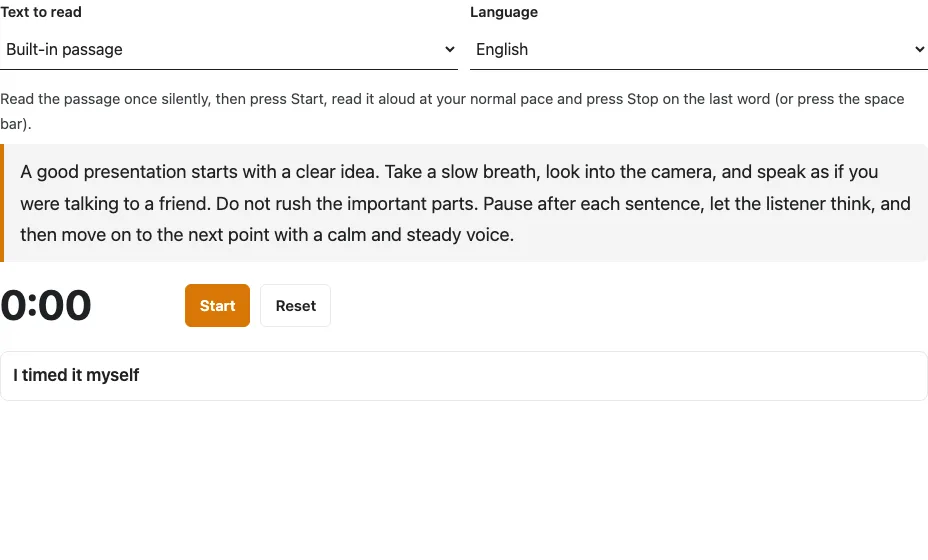
- Choose the Language and keep Built-in passage, or switch to My own text and paste what you will really read.
- Read the text silently once so you do not stumble on new words.
- Press Start (or the space bar) and read aloud at the pace you would use for the talk or video. Do not rush the first sentence.
- Press Stop as you say the last word, without waiting for the sentence to fade out.
- Read your speed, the band it falls in and the comparison table.
- For a steadier figure, press Try again and read again. A passage takes about 20 seconds, so one second of error moves the result by about 5%. Pasting a longer text of your own gives a smoother number.
- Press Save as my pace to store it in this browser. Saving a second result averages it with the first, so one bad take does not ruin the figure.
- If the result looks wrong, check that you pressed Stop on the last word: a time far outside the plausible range is rejected with a message instead of being saved.
- No time to read? Open I timed it myself and type the time you measured with another clock.
What is a good speaking speed?
There is no single answer, because ranges depend on the situation. VirtualSpeech lists 100 to 150 words per minute as a comfortable pace for presentations and 120 to 150 for conversation, and 150 to 160 for audiobooks, radio hosts and podcasters. A meta-analysis of 77 studies by Brysbaert (2019) found that adults read text aloud at an average of 183 words per minute in English.
What people actually do is slower. VirtualSpeech measured 32,809 practice presentations in 2026: the median was 111 words per minute, the middle half of speakers were between 86 and 133, and only 6% were faster than 160. Faster, more fluent speakers scored higher up to about 180 words per minute; the presentations scoring 8 out of 10 or more had a median of 138. Its own advice is to aim for about 120 to 160.
Is 200 wpm speaking too fast?
For most talks, yes. 200 words per minute is above every ordinary range above, above the 183 words per minute at which adults read text aloud, and, in VirtualSpeech’s practice data, above the speeds that scored best. Some speakers do it on purpose for energy; VirtualSpeech measured 201 words per minute in a Tony Robbins TED talk. If your test result is near 200, slow down by 10% and listen back to a recording.
How fast is 170 wpm speaking?
Fast. It is above the 150 to 160 of audiobooks and radio hosts and about 7% under the 183 words per minute of reading aloud. Debatrix uses 170 as its “fast speaker”. Only 6% of VirtualSpeech’s practice presentations were faster than 160. In this test, 170 words per minute is “brisk” in English, because it is 1.13 times the 150 starting pace.
How fast should I talk?
Choose the pace by the job and the listener. Slower for complex, technical or emotional material and for a second language; faster for a short, energetic clip. For a prepared read from a teleprompter, tool vendors suggest similar numbers: ReadCalc starts at 140 words per minute (2 August 2026), RemoteCue gives 130 to 150 for corporate video and GoTeleprompter 140 to 160 for creators on camera. These are guidance from companies that sell prompters, not research; your own measured pace is the better start.
Which languages does the test cover?
Thirteen languages have a built-in passage. Each is a short, plain text with no names or digits. The “Typical time” column is how long the passage takes at the language’s starting pace, which is what a “typical” result looks like.
| Language | Passage length | Starting pace per minute | Typical time |
|---|---|---|---|
| English | 54 words | 150 | 22 s |
| Español | 54 words | 160 | 20 s |
| Français | 49 words | 155 | 19 s |
| Deutsch | 57 words | 135 | 25 s |
| Italiano | 50 words | 155 | 19 s |
| Nederlands | 51 words | 145 | 21 s |
| Português (Brasil) | 53 words | 155 | 21 s |
| 日本語 | 125 characters | 300 | 25 s |
| 한국어 | 111 characters | 330 | 20 s |
| 繁體中文 | 83 characters | 240 | 21 s |
| 简体中文 | 84 characters | 240 | 21 s |
| العربية | 38 words | 125 | 18 s |
| Русский | 44 words | 130 | 20 s |
The Simplified Chinese and Russian passages were written for this tool and have not been read by a native speaker yet; they only need to read naturally at a normal pace. For other languages use My own text.
Why can I not compare words per minute across languages?
Words differ in length and syllables carry different amounts of information. A study of 17 languages by Coupe and colleagues (2019, Science Advances) found that languages encode information at similar rates, about 39 bits per second, even though their speech rates and the information in each syllable differ widely. So a higher word count per minute in one language does not mean its speakers talk faster. This test therefore compares you with the starting pace of your own language, and gives characters per minute for Japanese, Chinese and Korean, whose writing has no spaces. The English comparison table is shown for English only.
Which teleprompter speed should I use?
Start the scroll at your measured pace, rounded to 5. If it feels rushed, lower it by 5 words per minute at a time. The number on a prompter’s speed slider is not words per minute, so the link under the result opens the teleprompter speed calculator, which converts your pace into pixels per second for your font size and screen width.
How this tool works and where the numbers come from
Rate = spoken units / seconds x 60, using the Prompterline core measurement: units are words, or characters for Japanese, Chinese, Korean and Thai; a time that gives under 0.4 or over 2.6 times the language’s starting pace is rejected as a mistake. Bands compare your rate with the language’s starting pace (English 150): below 0.75 slow, 0.75 to 0.9 relaxed, 0.9 to 1.1 typical, 1.1 to 1.25 brisk, above 1.25 fast. A saved result moves the stored pace 80% of the way to it the first time and 50% after that. Ranges shown for English come from the sources below and measure different situations.
Sources
Questions, briefly answered
How can I test my speaking speed?
Read a passage of known length aloud with a timer, then divide the words by the minutes. This page does the division for you: 54 words in 24 seconds is 54 / 24 x 60 = 135 words per minute.
What is a good speaking speed?
For presentations, 100 to 150 words per minute is a comfortable range and 120 to 160 is a common target (VirtualSpeech). Audiobook and radio pace is 150 to 160.
How many words per minute do I speak?
Published English figures run from 110 words per minute for a slow speaker to 170 for a fast one (Debatrix), so a result in that range is ordinary. Take the test twice and use the average.
Is a speaking speed test accurate without a microphone?
It measures what the stopwatch measures: the time from your Start to your Stop. A microphone-based test needs microphone permission and depends on the browser’s speech recognition. Here you press Stop when you finish the passage, so a skipped sentence is not noticed; times that are impossibly short or long are rejected.
Does reading aloud match my normal speaking speed?
Not exactly. Reading aloud is steadier than free speech and has fewer hesitations. Brysbaert’s 183 words per minute for reading aloud is above the 111 median that VirtualSpeech saw in practice presentations. Use the result as the pace of a prepared read.
Can I test in another language?
Yes, in 13 languages with a built-in passage, or in any language with My own text.
Can I use the result in the other tools?
Yes. Press Save as my pace. The script timer and the speech length calculator list it as My saved pace, and the teleprompter speed page starts from it. It stays in this browser only.
Is this a typing test or a words per minute counter?
No. A typing test counts words typed per minute. This test counts words spoken, so use it for talks, voice-overs and a teleprompter pace.
Related tools
- Script timer: time a script at your saved pace.
- Speech length calculator: fit a talk into a slot at your pace.
- How many words is a 5-minute speech: which of three paces is yours.
- Teleprompter speed: turn your pace into a scroll speed.
- Script Formatter: clean a script so it reads well on a teleprompter.
- Script timing tools: the whole group in one place.