
What Is a Teleprompter?
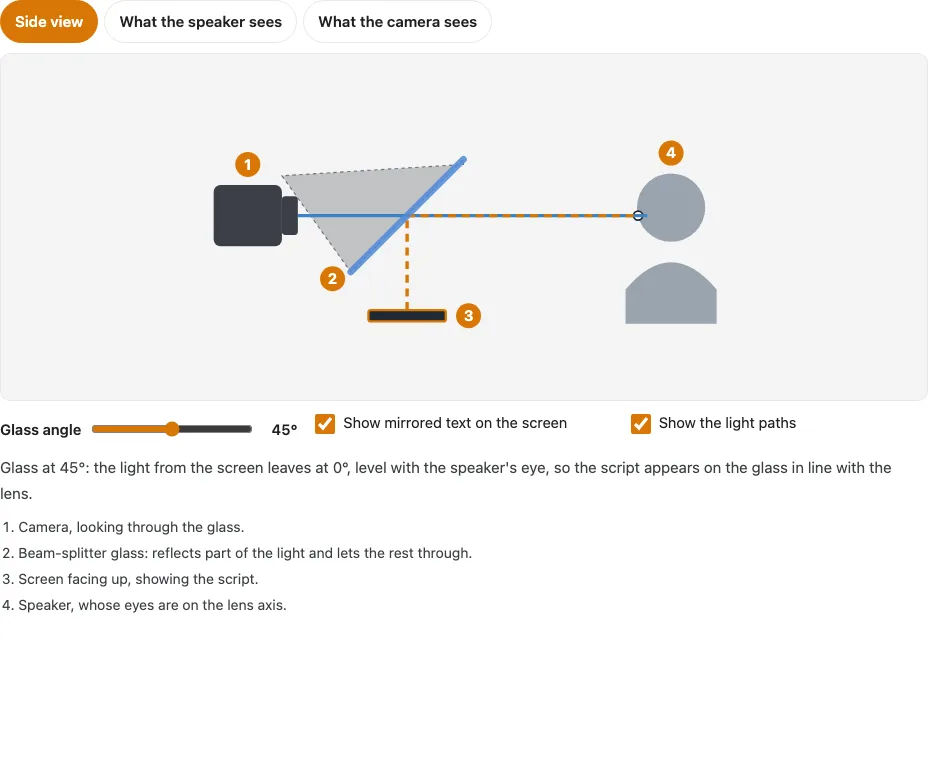
What is a teleprompter: a screen that shows your script on angled glass in front of the camera lens. You read the words while looking at the lens, and the camera sees only you. The demo is a two-dimensional model with the screen kept fixed, so real rigs that tilt the screen give different numbers.
Free · runs in your browser · nothing is uploaded
What is a teleprompter? It is a display, also called an autocue, that shows a script as scrolling text in front of a camera so the speaker can read it and still look straight into the lens. The text sits on a pane of partly reflective glass that is tilted in front of the lens. It bounces the screen toward the speaker’s eyes and lets the light from the speaker pass through to the camera, so the viewer sees eye contact and never sees the words. The demo above is a side view you can change: move the glass, flip the screen text, and compare what the speaker and the camera each see. Below it you find how the optics work, the history from 1950 with dated sources, and the kinds of teleprompter in use.
Open the online teleprompter to scroll your own script at a set speed.
At a glance
A teleprompter is a display, also called an autocue, that shows a script as scrolling text in front of a camera so the speaker can read it and still look straight into the lens. The text sits on a pane of partly reflective glass tilted in front of the lens.
- The reflected angle equals 2 x glass angle - 90 degrees, which is why a glass at 45 degrees sends the light out level.
- The first teleprompter was used on live television on 4 December 1950.
- The demo's glass angle slider runs from 30 to 60 degrees in steps of 1 degree.
- The demo is a two-dimensional model of the optics, and the model keeps the screen fixed.
- A confidence monitor is a kind of teleprompter that has no glass at all.
How to use the demo
- Start in Side view. The camera is on the left, the speaker on the right, the screen faces up under the glass.
- Leave Glass angle at 45 degrees. The orange dashed line from the screen bounces off the glass and runs level into the speaker’s eye.
- Drag the slider to 38 or 52 degrees. The reflected line misses the eye and the sentence under the drawing says whether the text would land under or over the lens.
- Open What the speaker sees. At 45 degrees the script floats on the glass over the lens. At other angles it drifts away and fades.
- Untick Show mirrored text on the screen. The glass now shows the words back to front, because a mirror swaps left and right.
- Open What the camera sees. The camera records only the speaker.
- Untick Show the light paths in Side view if you want the drawing without the rays.
- Watch the sentence under the drawing while you move the slider between 30 and 60 degrees. It gives the angle the light leaves the glass at, 2 x glass angle - 90, and says whether the text lands level with the lens, under it or over it.
- The three views are buttons and the slider takes the arrow keys, so the demo works from the keyboard.
How does a teleprompter work?
A teleprompter works because a pane of angled glass both reflects and transmits light. The screen’s light reflects off the glass toward the speaker’s eyes, while light from the speaker passes through the glass into a lens hidden behind it. The speaker reads text that sits in line with the lens.
In order, the light does this:
- A screen under the glass faces up and shows the script as text that is already mirrored.
- The screen’s light hits the glass and is reflected toward the speaker’s eyes.
- Light from the speaker travels the other way, through the glass, into the lens. A shroud around the lens keeps stray light out.
- The speaker sees the text apparently floating at the lens. The camera sees only the speaker.
Wikipedia compares the effect with Pepper’s ghost, the stage illusion. In the demo, the reflected angle equals 2 x glass angle - 90 degrees, which is why a glass at 45 degrees sends the light out level:
| Glass angle | Reflected light leaves at | Where the text lands |
|---|---|---|
| 40° | 10° below level | Under the lens |
| 45° | Level | On the lens |
| 50° | 10° above level | Over the lens |
| 60° | 30° above level | Far over the lens |
Why is the screen text mirrored?
A mirror swaps left and right, so a screen showing normal text would look reversed on the glass. The screen therefore shows mirrored text, and the reflection reads correctly. Wikipedia notes that news prompter monitors have the scanning reversed for this reason, and the usual look is white text on black with cues in inverse video.
The online teleprompter has a mirror button for this, and Mirror text mirrors text or an image.
A short history of the teleprompter
The first teleprompter was used on live television on 4 December 1950. It was a paper scroll, and the glass version came later. Each date below is quoted from the source named in its row, and where sources disagree the text after the table says so.
| Date | What happened | Source |
|---|---|---|
| 21 April 1949 | Actor Fred Barton Jr. files a patent application for the “TelePrompTer”; it is granted on 24 April 1953 | HISTORY (2024) |
| 4 December 1950 | First use, on the CBS soap opera The First Hundred Years. Barton, engineer Hubert Schlafly and Irving B. Kahn found the TelePrompTer Corporation | Wikipedia; HISTORY (2024) |
| 1952 | Herbert Hoover addresses the Republican National Convention using a prompter designed by Schlafly | Wikipedia |
| 4 January 1954 | Dwight Eisenhower is the first president to use one for a State of the Union address | Wikipedia |
| 1955 | Luther George Simjian patents an in-camera teleprompter. Senator Richard Neuberger proposes that politicians must say when they use one | HISTORY (2024); Wikipedia |
| 1956 | Glass teleprompters appear at both the Democratic and Republican conventions | Wikipedia (quoting Schlafly) |
| 1982 | CompuPrompt, the first personal-computer teleprompter, runs on an Atari 800 | Wikipedia |
| 1996 | The Democratic convention uses four prompters, including a large confidence monitor under the broadcast cameras | Wikipedia |
| 20 April 2011 | Hubert Schlafly dies at 91 | Wikipedia; Philadelphia Inquirer |
The sources disagree on some firsts: HISTORY says Harry Truman used one for a 1951 State of the Union, Wikipedia names Eisenhower in 1954, and the two credit the in-the-lens idea to different people (Oppenheimer, Simjian). Each date here names its source, and the page does not pick between them.
What kinds of teleprompter are there?
Teleprompters differ in the screen, the glass and where they sit. Phone and tablet rigs, camera-mounted glass, desktop units for webcams, studio prompters and glass pairs for lecterns are the common ones. A confidence monitor is the exception, because it has no glass at all.
| Kind | Screen and glass | Typical use | Source |
|---|---|---|---|
| Phone or tablet rig | Your phone or tablet under a small glass | Solo creators, short videos | Neewer |
| Camera-mounted glass | Glass in front of a DSLR or mirrorless lens | Interviews, professional video | Neewer |
| Desktop or webcam unit | Glass in front of a webcam or monitor | Video calls, webinars, teaching | Neewer; Elgato |
| All-in-one | Built-in display, for example a 9-inch screen on a USB-C cable | Desk and studio use | Elgato |
| Glass pair for a lectern | Two angled panes either side of the speaker, screens in the base | Conventions and speeches | Wikipedia |
| Confidence monitor | A plain screen under the broadcast cameras, no glass | Conventions, conferences | Wikipedia |
How this tool works and where the numbers come from
The demo is a two-dimensional model of the optics: the screen faces straight up under the glass, the camera looks along a horizontal axis, and the screen’s light is reflected by the law of reflection. A ray leaving a screen that faces up and hitting glass tilted at an angle t from the camera axis leaves at 2 x t - 90 degrees from that axis, so it is level at 45 degrees. The demo counts the text as seen when the reflected ray passes within a small distance of the speaker’s eye. Real rigs also let you tilt the screen, which changes the numbers; the model keeps the screen fixed to show why the angle matters. History dates are quoted from the sources named in the table, and where two sources disagree both are given.
Sources
- Wikipedia, Teleprompter (history, optics, glass teleprompters, confidence monitors), read 2026-10-25
- HISTORY, Who Invented the Teleprompter? by Lesley Kennedy, published 2024-09-16, updated 2025-05-27
- Elgato, What is a Teleprompter? (beam splitter, setups, users), updated 2026-04-07
- The Philadelphia Inquirer, Hubert J. Schlafly, teleprompter inventor, 91 (obituary), 2011-04-30
- Neewer, What Is a Teleprompter (types, placement), read 2026-10-25
Questions, briefly answered
What is a teleprompter used for?
A teleprompter lets a speaker read a script while looking at the camera. News anchors and award-show presenters are the best known users. Elgato also lists video creators, people filming training videos and company announcements, presenters on video calls, and streamers who want to watch chat without looking away.
Does the camera see the text?
No. The glass reflects the screen toward the speaker, and the lens behind the glass records the speaker through it. A shroud around the lens blocks light from the screen side. Open the demo’s third view for the camera’s picture: the speaker, with no words and no glass.
How does a teleprompter look to the speaker?
On the glass the script floats over the lens, like a transparent caption in front of the camera. When the glass is at the right angle the text is level with the lens, so reading it means looking at the lens. The demo’s second view shows this.
Who invented the teleprompter and when?
Hubert Schlafly, Fred Barton Jr. and Irving B. Kahn developed the first one, and it was first used on 4 December 1950 on the CBS soap opera The First Hundred Years. Barton filed the patent application in 1949, and the three men founded the TelePrompTer Corporation. Schlafly died in 2011, aged 91.
What is the difference between a teleprompter, an autocue and a confidence monitor?
A teleprompter and an autocue are the same kind of device: “TelePrompTer” was a trade name and Autocue is another one, used mostly in Commonwealth countries. Autoscript is the brand name used in the US. A confidence monitor is a plain screen near the cameras with no glass, so the speaker looks at the screen, not the lens.
How does a presidential teleprompter work?
A presidential teleprompter is a pair of angled glass panes on either side of the lectern, with screens in the base that send their light up to the glass. The speaker sees the text. The audience sees what looks like clear glass. Switching between the two panes makes the speaker seem to address the whole hall.
Do presidents use teleprompters?
Yes, for many decades. Wikipedia names Dwight Eisenhower’s State of the Union on 4 January 1954 as the first presidential use, and HISTORY reports that Donald Trump’s teleprompter failed in the rain during a speech on 4 July 2019. Wikipedia illustrates the four-prompter convention setup with a photograph of Barack Obama’s 2008 convention speech in Denver.
What does a teleprompter do?
It scrolls your script as large text in front of the camera lens, so you read while looking at the lens. The audience sees only you.
Related tools
- Online teleprompter: scroll your own script at a set speed, with a mirror button for glass.
- How to use a teleprompter: a five-step practice on a real prompter.
- Mirror text: mirror text or an image for teleprompter glass.
- Teleprompter speed: turn your speaking pace into a scroll speed and a font size.
- Speaking speed test: measure your own words per minute before you set a prompter.
- Voice-Activated Teleprompter: check whether your browser can follow your voice on-device.
- Teleprompter guides: the whole group in one place.